DC7: Augmented reality framework for visualizing airborne infectious pathogens in the operating room during surgery

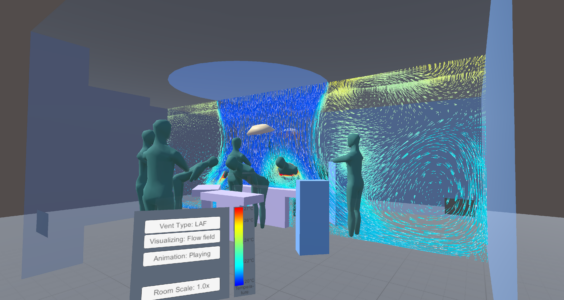
Objectives: to develop augmented reality platform for visualizing dynamic volumetric data such as airborne contaminants based on a grid of point-wise measurements. Expected Results: Increased awareness among medical personnel related to airborne particle contamination; A visualization framework for augmented and virtual reality devices that can visualize a complex 3D fields …

DC8: Low-order modelling and compressed sensing for real-time flow modelling in operating rooms

Objectives: to develop a tool for real-time analysis of the dynamic airflow in operating rooms using a limited set of measurements. Expected Results: Validated low-order models for the airflow within operating rooms and healthcare facilities. Active strategies to improve air quality, based on the developed models. Improve the knowledge of …

DC9: Enabling instantaneous measurements of Aspergillus spores in healthcare air

Objectives: To develop physical models able to identify and quantitate Aspergillus spores concentration in hospital air. To understand and standardize the correlation between airborne particles and Aspergillus concentration in indoor air. To define the airborne microorganisms’ distribution in hybrid operating rooms. Expected Results: Acquisition of a large dataset including particles …

DC10: Continuous Monitoring of Airborne Pathogens in health care facilities

Objectives: The project aims to develop a web-based system to allow monitoring of indoor air quality conditions in health care units focused on the concentration of airborne pathogens. Expected Results: Acquisition of a large dataset including data about indoor air quality, outdoor air quality. Understanding of health risks due to …

DC11: Modelling dispersion of microorganisms due to healthcare activities

Objectives: This research project aims to establish new data to describe the dispersion of airborne microorganisms from healthcare activities and incorporate it into a computational model to carry out exposure risk assessments. Expected Results: An experimental protocol for characterizing microbial sources in a chamber environment; A set of experimentally derived …

Lauching HumanIC project

On the first of January 2024, we began our adventure together as part of the HumanIC project.Over the next 4 years, we will strive to train great professionals, researchers who will have a deep understanding of the complex processes in healthcare facilities and who, in the years to come, will …